
The interferometer for microsecond high-speed phenomena
The state of the art interferometer “DELTAPH” sustained by our unique High speed polarization camera “CRYSTA”. The system can measure phase shift image from one snapshot fringe image without mechanical scanning. Its high-speed and real-time capabilities allow the evaluation of fast-moving dynamic phenomena.
Conventional interferometers mechanically scan the reference mirror, so there is a limitation of frame rate, and they cannot measure instantaneous phenomena in one shot. However, our DELTAPH interferometer is now capable of one-shot measurement without mechanical drive by our proprietary polarization measurement technology.

Sound field imaging is one of the applications that requires high-speed and one-shot measurement. One-shot measurement is essential because sound travels through the air at a speed of 340 meters per second. Shutter speed of the DELTAPH interferometer is 1 microsecond or less with over 7,000 phase images per second. It’s possible to visualize sound propagation through the air without blur. Moreover, we have possibility of analyzing variation of related air density by sound travel because the image has quantitative phase information.
For other applications, It can measure slight change of surface shape cause of vibration or impact when the sample is placed instead of the reference mirror.
Application Example: Flow Visualization
1.Thermal Convection around a Soldering Iron
Heated air rises around a soldering iron, generating complex thermal convection.
The DELTAPH interferometer detects temperature-induced changes in the refractive index of air as phase information, enabling non-contact, tracer-free visualization of otherwise invisible thermal convection.
2.Pressure Waves and Airflow during High-Speed Projectile Launch
The air motion around the muzzle was recorded at 10,000 fps as a BB pellet was fired from an air gun.
Immediately after firing, a disturbance considered to be a pressure wave was observed propagating from the muzzle ahead of the BB pellet, followed by the pellet itself together with a jet of compressed air.
The DELTAPH interferometer detects minute changes in air density and refractive index caused by pressure variations as phase information, making it possible to visualize high-speed air motion that cannot be observed with the naked eye.
In this measurement, high-speed imaging at 10,000 fps resolved the pressure wave, compressed-air jet, and BB pellet launch over time.
3.CO₂ Gas Leakage
CO₂ gas was supplied through a tube with a small opening, and the leakage and subsequent dispersion of the gas into the surrounding air were visualized.
Because CO₂ and ambient air have different refractive indices, the refractive-index changes associated with gas leakage can be detected as phase information, allowing otherwise invisible gas behavior to be observed.
DELTAPH enables gas leakage and dispersion to be visualized under laboratory conditions without adding smoke, particles, or other tracers.
This technique can be applied to fundamental studies of gas flow and to comparisons of dispersion behavior under different conditions.
Application Example: Sound Field Imaging
1.Spherical Waves from an Ultrasonic Transducer
This example visualizes spherical waves radiated from a 40 kHz ultrasonic transducer.
Density variations associated with sound waves in air are detected as phase information, allowing normally invisible sound-wave propagation to be observed.
A metal plate is inserted partway through the video, revealing sound-wave reflection, interference between the incident and reflected waves, and diffraction as the waves propagate around the edge of the plate.
DELTAPH enables non-contact visualization of complex sound-field behavior without disturbing the sound field itself.
2.Propagation of Transient Sound Generated by Castanets
Frame rate: 100,000 fps
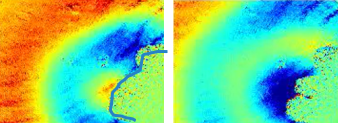
At the moment of the impact, we can see a strong, high-frequency spike (very narrow blue stripe near the impact zone) in the distribution.
After a few milliseconds, the frequency gradually decreases (stripe getting wider while propagating from the impact zone) and the wave decays.
This example visualizes the propagation of transient sound waves generated by striking castanets.
DELTAPH does not require synchronization with periodic sound waves or repeated measurements. Because the phase distribution at each instant can be acquired at high speed, non-periodic phenomena such as single impact sounds can also be observed.
In this measurement, imaging was performed at 100,000 fps, capturing the propagation of the strong sound wave generated immediately after impact and the subsequent evolution and decay of the sound field over several milliseconds.
DELTAPH can therefore visualize not only steady-state sound fields, but also rapidly changing transient acoustic phenomena such as impact sounds and other momentary acoustic events.
3.Ultrasonic Levitation
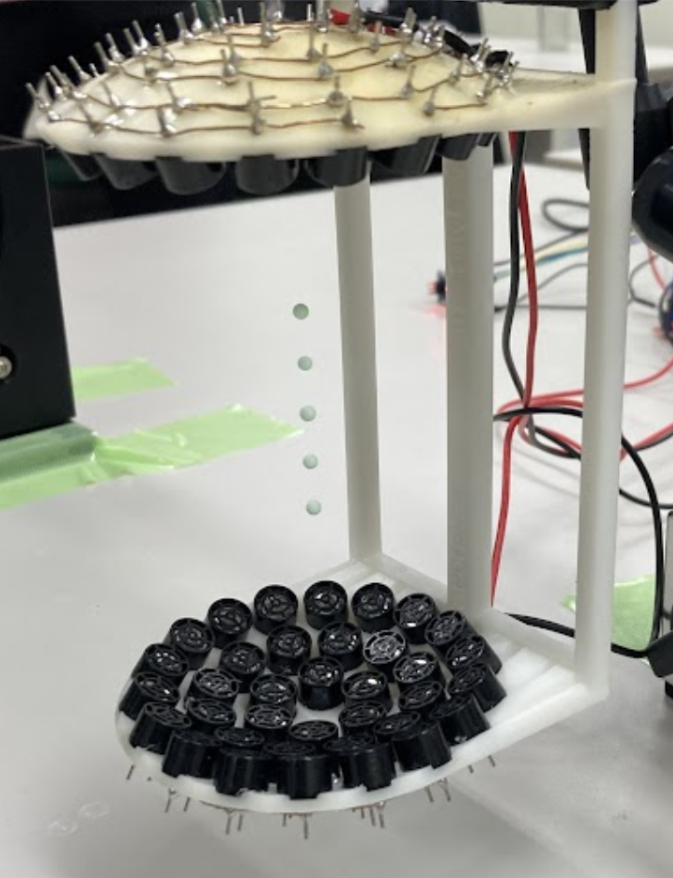
This example visualizes the sound field generated by an ultrasonic levitation system. Five polystyrene spheres are trapped within a standing wave formed by the ultrasonic field.
The DELTAPH interferometer detects density variations associated with ultrasonic waves propagating through air as phase information, enabling high-speed observation of the wavefronts around the levitated objects.
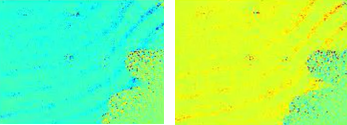
In addition, the relative amplitude distribution of the sound field can be visualized by calculating the RMS value of the temporal phase variation at each pixel in the recorded phase images.
The resulting distribution shows that the polystyrene spheres are trapped at positions corresponding to the nodes of the ultrasonic standing wave, providing a two-dimensional view of the structure of the levitation field.
By combining instantaneous wavefront imaging with the RMS distribution, the relationship between sound-field formation and trapping position in ultrasonic levitation can be evaluated visually.
Imaging collaboration: Assoc. Prof. Hasegawa, Kogakuin University.
|
Relative sound-field amplitude distribution (RMS phase fluctuation) |
Ultrasonic levitation system and five trapped polystyrene spheres |

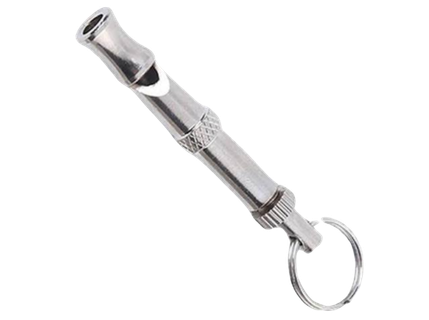
When the whistle is blown, both sound waves radiated from the whistle and airflow generated by the supplied air occur simultaneously.
DELTAPH records these phenomena within the same phase-image sequence by measuring refractive-index changes associated with variations in air density at high speed.
The acquired data contain both a rapidly oscillating sound-field component and more slowly varying density changes associated with airflow. By taking advantage of their different temporal characteristics, these components can be separated and visualized individually.
The video on the left shows the extracted sound-field component and the propagation of sound waves radiated from the dog whistle.
The video on the right shows density variations associated with airflow generated by blowing the whistle, after removal of the sound-field component.
In this way, multiple phenomena occurring on different time scales can be separated and analyzed from a single measurement dataset.
Key Differences with Conventional Interferometers
To measure the shape of an object, indirectly measured as surface “phase”, with an interferometer, we traditionally use a reference surface whose position needs to be adjusted and scanned during the measurement, making the whole process not suitable for moving objects, especially at high speeds.

Conventional interferometer needs scanning of the mirror

The DELTAPH possibles to measure phase image by one-shot usning our polarization camera.