Cutting – Non-Contact Temperature Analysis of Cutting Points
Non-Contact Temperature Analysis of Cutting Points
Metal processing is one of the advanced technologies that support Japanese manufacturing.
For example, parts for industrial turbines and various engines used in the aerospace and nuclear industries are made of super heat-resistant alloys that can withstand harsh operating environments.
While these alloys have excellent high-temperature properties such as heat resistance and corrosion resistance, their low thermal conductivity causes, when cutting those materials, locally generated heat to concentrate on the tool cutting edge. Cutting tools and machining tips made of similar alloys are also used to machine these super heat-resistant alloys.
In machining these metals, optimization of machining conditions has been a longstanding issue.
This is because under conditions where cutting heat tends to concentrate locally, chemical reactions with the cutting tool material and adhesion of adhesives occur, leading to reduced tool life, cutting edge wear and chipping, and reduced quality of the machined surface. Therefore, it is necessary to devise ways to prevent heat buildup in the setting of machining conditions. However, temperature conditions at the cutting point are difficult to measure, and it has been difficult to quantitatively evaluate the relationship between the rotational speed and cutting point temperature.
Against this background, manufacturers of cutting tools have started an attempt to analyze cutting point temperatures with a non-contact, high-speed method using a cooled infrared camera, from our products.
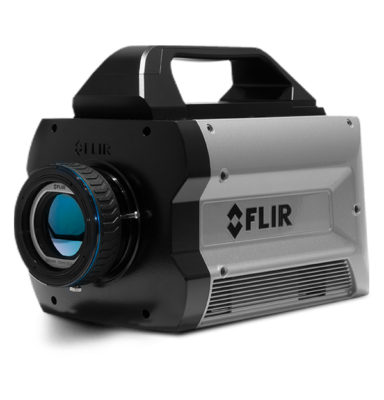
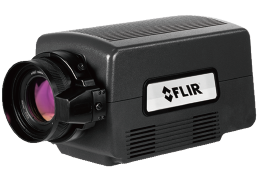
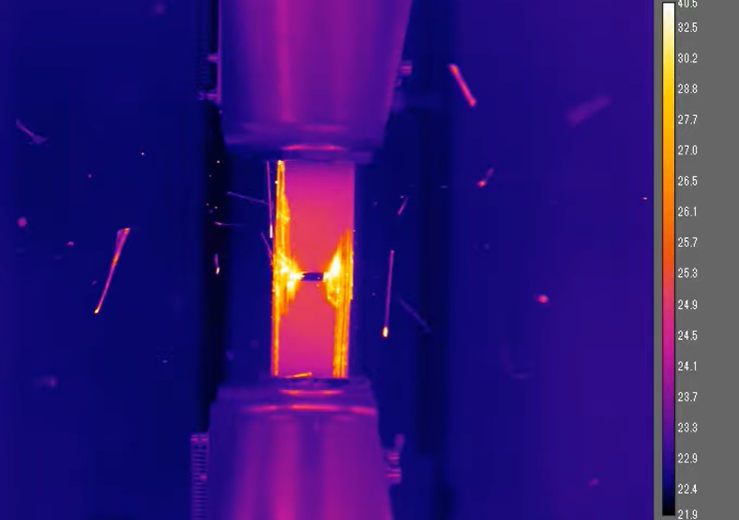
A mid-infrared camera, X6901sc, is used for this measurement. The observation area is as small as one chip, and temperature values are output and recorded through a window transparent to infrared light, taking into account the emissivity of the super heat-resistant alloy.
The image capture rate is 5,000 shots per second, and the integration time, which corresponds to the exposure time, is even shorter, resulting in a clear temperature image with minimal blurring. This type of measurement is applied not only to cutting processes but also to visualization of molten pool temperature in metal welding.
The results of this measurement make it possible to study the optimization of machining conditions from a more quantitative perspective, which in the past was nearly impossible to study and was an individualistic process.